Showing posts with label Language. Show all posts

Saturday, November 29, 2008

くんよみ (Kunyomi) and おんよみ (Onyomi)

Another wrinkle I've been facing lately is the complexity added by くんよみ (kunyomi) and おんよみ (onyomi), i.e. the multiple readings for kanji characters. Kunyomi is the Japanese pronunciation and is largely used when kanji characters are alone. Onyomi comes from the original Chinese pronunciation and is largely used when kanji are combined. Of course, many kanji have even multiple onyomi and kunyomi pronunciations!
.
For example...
Alone using kunyomi:
新 (new) あたらしい (atarashii)
車 (car) くるま (kuruma)
.
Together using onyomi:
新車 (new car) しん しゃ (shin sha)
.
Alone using kunyomi:
火 (fire) ひ (hi)
山 (mountain) やま (yama)
.
Together using onyomi:
火山 (fire mountain = volcano) かざん(kazan)

Sunday, November 9, 2008

カタカナ (Katakana)

Katakana is one of the 3 alphabets used in Japan. It is largely the province of adopted foreign words such as デパート (depa-to = department store), アメリカ (America) and テレビ (terebi = television). It's sort of a game I play to try to figure out what signs in Katakana mean. Here's a few I've seen recently - see how you do! Remember, Japanese has no sound for 'l' so 'r's can be 'l' or 'r' sounds. Also, almost all characters are consonant-vowel combinations (vowels and 'n' are exceptions) so double consonants (th, sh, br, tr, st, etc.) and words ending with consonants are rare - you'll see almost all words are consonant-vowel-consonant-vowel. (answers below)
.
1. レストラン (resutoran)
2. アップル (apuru)
3. ゴルフ (gorufu)
4. エスカレーター (esukare-ta-)
5. トンネル (tonneru)
6. クリスマス (kurisumasu)
7. ボックス (bokusu)
8. スケジュール (sukejyu-ru)
9. スチール (suchi-ru)
10. ブライアン エンゲル (buraian engeru)

photo: tatoo which says 'kyasarin' (presumably Katherine or Kathleen)

1. restaurant
2. apple
3. golf
4. escalator
5. tunnel
6. Christmas
7. box
8. schedule
9. steel

10. Brian Engel

Thursday, September 11, 2008

Kanji

I have much to say about the presidential race but that will wait until the weekend. For now, I'll restrict my post to my latest encounter in Japanese: kanji. Hiragana is the general syllabic alphabet, katakana is the syllabic alphabet for words of foreign origin, and kanji is the last frontier; it's the logographic (pictogram) alphabet.
.
It occurred to me that with kanji now in the mix, that the level of difficulty is significantly higher. For the majority of English words, there is a one-to-one correlation between the object and the word and that is all you need to know.
.
1. See moon and recall the word "moon".
2. See the word "moon" and recall a picture of the moon.
Many kanji represent more than one object and almost all have at least two pronunciations. That gives the following relationships:

1. See the moon and recall the word "つき".

2. See the moon and recall the kanji character "月".

3. See the word "つき" and recall a picture of the moon.

4. See the word "つき" and recall the kanji character "月".

5. See the kanji character "月" and recall the word "つき".

6. See the kanji character "月" and recall a picture of the moon.

7. See the kanji character "月" and recall "month".

8. See the kanji character "月" and recall the words "げつ" and "がつ".

9. Think of "month" and recall the kanji character "月".

10. Think of "month" and recall the words "げつ" and "がつ".

11. See the words "げつ" and "がつ" and recall the kanji character "月".

12. See the words "げつ" and "がつ" and recall the word "month".

Saturday, August 30, 2008

Dispatches from Nihongo

My latest "oy-vey moment" with Japanese came during this past week's lesson.
.
Counting in English:
One, two, three... regardless of what the items are (a few exceptions for things like floors - first, second, third...).
.
Counting in Japanese:
Numbers: ichi, ni, san...
Things: hitotsu, futatsu, mittsu...
People: hitori, futari, sannin...
.
Clothes: icchaku, nicchaku, sancchaku...
Not to be confused with:
Socks and Shoes: issoku, nisoku, sanzoku...
.
"Small Things": ikko, niko, sanko...
Not including:
"Small Animals, Fish & Insects": ippiki, nihiki, sanbiki...
.
I swear I'm not making this stuff up:
Drinks: ippai, nihai, sanbai...
Houses: ikken, niken, sangen...
Machines and Vehicles: ichidai, nidai, sandai...
Books and Notebooks: issatsu, nisatsu, sansatsu...
"Thin and Flat Things": ichimai, nimai, sanmai...
"Thin and Long Things": ippon, nihon, sanbon...
.
Dear lord!

Friday, July 25, 2008

What I'm Up Against

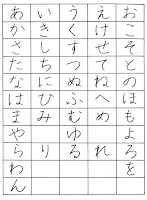
A week and a half ago, I started private lessons with a Japanese teacher. My first task is to learn the second alphabet: katakana. As if it were not difficult enough to learn 2 alphabets plus the thousands of kanji characters, I am also up against the similarities between characters....

Hiragana characters:
き and さ
こ and に
め, の, あ, and ぬ
ね and ぬ
る, ろ, and そ
は , ほ, and ま
れ , わ, and ね
り and い

Katakana characters:
ノ, ン, ソ, シ, and ツ
ウ, ク, ケ, ス, タ, ヌ, フ, ラ, ワ, and ヲ!
チ and テ
メ and ナ
ユ and コ

Thursday, June 5, 2008

Joy of Language

Thanks to Uncle Jerry for sending this along to me.  I googled these words and found many sites with them and most sites attributed the contest to the Washington Post, although I did not succeed in finding the original material on the Post website.  Nevertheless, this is great fun.  Funny and intelligent.  Quite a good combination.  Enjoy.
.
Part I: Supply alternative meanings for common words.
1. Coffee (n), the person upon whom one coughs.
2. Flabbergasted (adj), appalled over how much weight you have gained.
3. Abdicate (v), to give up all hope of ever having a flat stomach.
4. Esplanade (v), to attempt an explanation while drunk.
5. Willy-nilly (adj), impotent.
6. Negligent (adj), describes a condition in which you absent mindedly answer the door in your nightgown.
7. Lymph (v), to walk with a lisp.
8. Gargoyle (n), olive-flavored mouthwash.
9. Flatulence (n) emergency vehicle that picks you up after you are run over by a steamroller.
10. Balderdash (n), a rapidly receding hairline.
11. Testicle (n), a humorous question on an exam.
12. Rectitude (n), the formal, dignified bearing adopted by proctologists.
13. Pokemon (n), a Rastafarian proctologist.
14. Oyster (n), a person who sprinkles his conversation with Yiddishisms.
15. Frisbeetarianism (n), (back by popular demand): The belief that, when you die, your Soul flies up onto the roof and gets stuck there.
16. Circumvent (n), an opening in the front of boxer shorts worn by Jewish men.
.
Part II: Take any word from the dictionary, alter it by adding, subtracting, or changing one letter, and supply a new definition.
1. Bozone (n): The substance surrounding stupid people that stops bright ideas from penetrating. The bozone layer, unfortunately, shows little sign of breaking down in the near future.
2. Foreploy (v): Any misrepresentation about yourself for the purpose of getting laid.
3. Cashtration (n): The act of buying a house, which renders the subject financially impotent for an indefinite period.
4. Giraffiti (n): Vandalism spray-painted very, very high.
5. Sarchasm (n): The gulf between the author of sarcastic wit and the person who doesn't get it.
6. Inoculatte (v): To take coffee intravenously when you are running late.
7. Hipatitis (n): Terminal coolness.
8. Osteopornosis (n): A degenerate disease. (This one got extra credit.)
9. Karmageddon (n): its like, when everybody is sending off all these really bad vibes, right? And then, like, the Earth explodes and it's like, a serious bummer.
10 Decafalon (n): The grueling event of getting through the day consuming only things that are good for you.
11. Glibido (v): All talk and no action.
12. Dopeler effect (n): The tendency of stupid ideas to seem smarter when they come at you rapidly.
13. Arachnoleptic fit (n): The frantic dance performed just after you've accidentally walked through a spider web.
14. Beelzebug (n): Satan in the form of a mosquito that gets into your bedroom at three in the morning and cannot be cast out.
15. Caterpallor (n): The color you turn after finding half a grub in the fruit you're eating.
And the pick of the literature:
16. Ignoranus (n): A person who's both stupid and an asshole.

Friday, May 23, 2008

Language (and Culture) Exchange

The blog posts are backing up again... hopefully I can write a few this weekend in between school work, Ph.D. corrections, and wedding planning.
.
In the meantime, I'll write a short post about my language exchange. Yesterday I met my regular language partner, Minae, at our usual place (Starbucks) at our usual time (6:15-8:00pm). We speak about 1/2 in English and 1/2 in Japanese (well she teaches me basic Japanese vocabulary for 1/2). During our English conversations, I find that we're also having a cultural exchange. We often talk about what's going on in our lives which leads to questions such as "is it true that in America..." or "I heard that the Japanese..." I really look forward to our weekly get togethers.
.
Yesterday's tidbits:
  • Apparently there are "host" and "hostess" clubs which are fairly common in Japan. In the former, women go for drinks and find themselves surrounded by attractive men who are there to flatter and entertain them. It seems a bit strange to me, although that's not the first thing and I'm sure it won't be the last that confounds me.
  • Fold (ori) + Paper (gami) = origami
  • Hand (te) + Paper (gami) = letter (tegami)
  • A telling saying in Japan is that the nail which sticks out gets hammered. How true! That explains a lot about this culture of compliance and "harmony."

Saturday, March 29, 2008

Learn Two, Get One Free!

I'm loving learning Japanese. Finding patterns and figuring things out is very satisfying. This week, I picked up a few tidbits:
.
Sometimes two words combine into another related word:
mitten (tebukuro) = hand (te) + bag (bukuro)
zebra (shimauma) = stripe (shima) + horse (uma)
.
Words which deal with transportation end in sha:
bike = jitensha
car = jidosha
train = densha
.
Insect names end with mushi:
ladybug = tentomushi
snail = dendenmushi
.
I find that figuring out language is like a puzzle (with the three alphabets being an added level of difficulty) which is something I really enjoy. Incidentally my lovely fiancee laughs at my (effective) memory technique in which I try to create "hooks" for new words. For example, for the word ladybug (てんとうむし = tentomushi) I picture 10 ladybugs on my toe!

Wednesday, March 26, 2008

English and Japanese

As I'm trying to learn Japanese (the book I'm working on is for a 4-year old -- how's that for a knock on your ego?), I'm realizing things about both Japanese and English. Both Yumi and my language partner, Minae have lots of problems with articles (a, an, the) because Japanese doesn't have them. They are kind of silly if you think about it. They don't serve a purpose and we use them seemingly indiscriminately. To wit:
.
He is going home.
He is going to the store.
.
I want coffee.
I want a candy bar.
.
Why does store have an article but home doesn't and why does coffee not need an article while candy bar does?
.
Just musings from a curious mind.

Friday, March 21, 2008

Six-Word Memoirs

I heard about this idea on NPR (Talk of the Nation) and thought it was really neat. Legend has it that Ernest Hemingway was asked to write an entire story in 6 words and replied: "For Sale: baby shoes, never worn."
.
So two authors (Larry Smith and Rachel Fershleiser) picked up the idea, got thousands of responses from people, and have put them into a book called "Not Quite What I Was Planning: Six-Word Memoirs from Writers Famous and Obscure." There is also a website where people continue to submit memoirs.
.
A few others*:
After Harvard, had baby with crackhead.
She said she was negative. Damn.
Joined Army. Came out. Got booted.
I still make coffee for two.
Baby teeth. Buck teeth. No teeth.
Finally a mother. Destination China. Exultation.
.
Here's my first shot at it: Itinerant idealist. Six continents. Still searching.
.
I'd love to see your six-word memoirs in the comments section.
.
*by: Robin Templeton, Ryan McRae, Johan Baumeister, Zak Nelson, Harlan Stanton, Michelle Allen.

Sunday, March 9, 2008

Engrish

First a caveat: no one should be too critical of bad English in a foreign country because we, who come from English-speaking countries, rarely speak a second language at all, so who are we to criticize? Nevertheless, Japanese Engrish can be quite amusing. My quite fluent fiancee has a t-shirt I make fun of which says, "Dogs is Best Friend." I actually took the associated picture at the train station closest to my house for a website I regularly read called Japundit which is all about Japan (and I listen to the weekly podcast, as well). The website has all manner of things-Japan including funny things like Engrish. (P.S. If you couldn't figure out what the sign is supposed to mean, it's instructing us not to run to catch a train).