Showing posts with label Japan. Show all posts

Friday, September 18, 2009

Baby Names

Just curious what y'all think about the treacherous territory that is baby names in an intercultural relationship.

Ironically, as an American, I prefer to give our son a Japanese name. My wife, prefers western names. It is likely that we will live most of our lives in the U.S. and my position is that I want him to remain connected to his Japanese roots (in a concrete way). My wife wants him to be able to fit in.

Any thoughts? I'm especially looking to hear from those of you in mixed marriages. or of mixed parentage. Please indicate whether you live in Japan or abroad and if this factored into your decision.

Thanks!

Sunday, March 22, 2009

WBC = Why Bother Competing?

I have to say that I did enjoy seeing the WBC game here at the Tokyo Dome, even though Korea defeated Japan in a 1-0 pitcher's duel. I especially liked watching the phenom Yu Darvish pitch an inning of relief and the frenzy which took place every time Ichiro came to the plate. I love watching Ichiro play - he has one of the best swings in baseball in all of the time I've watched the sport -- up there with Pete Rose and Wade Boggs. He makes it seem so effortless.


But back to the larger WBC in general - it is horrible way to determine a "world champion." Unlike soccer or American football, or even basketball, where the better team regularly beats inferior teams, baseball regularly has inferior teams defeating superior teams. That is why it takes a 162-game schedule to determine the best teams and a 7-game series to determine the champion. Games are often won and lost based on the better pitcher but a particular pitcher only goes once every 4 or 5 games. I also don't like how the same teams keep playing the same teams but not others. The U.S. played Venezuela (in different rounds for different stakes) 3 times and Japan and Korea have squared off 4 times already (possibly one more time) while some teams never play each other. It is also just plain stupid that teams which have already qualified for the next round play each other to determine the seeding. It's a pointless game.

Not that anyone has asked, but if it were up to me I'd make it similar to the UEFA Champions League or World Cup. Maybe pare it back to 15 teams: 3 groups of 5. Each team plays every other team in its group twice for a total of 8 games per team. Take the top team from each group plus the top second-place finisher. Then those final four teams play a 3-game semi-final series followed by a 3- or 5-game final. The winning team would play 8 preliminary games, 3 semi-final games, and 3 or 5 finals games for a total of 14-16 games. If the early rounds are run concurrently, it can all be done in early to late March.

Saturday, November 29, 2008

くんよみ (Kunyomi) and おんよみ (Onyomi)

Another wrinkle I've been facing lately is the complexity added by くんよみ (kunyomi) and おんよみ (onyomi), i.e. the multiple readings for kanji characters. Kunyomi is the Japanese pronunciation and is largely used when kanji characters are alone. Onyomi comes from the original Chinese pronunciation and is largely used when kanji are combined. Of course, many kanji have even multiple onyomi and kunyomi pronunciations!
.
For example...
Alone using kunyomi:
新 (new) あたらしい (atarashii)
車 (car) くるま (kuruma)
.
Together using onyomi:
新車 (new car) しん しゃ (shin sha)
.
Alone using kunyomi:
火 (fire) ひ (hi)
山 (mountain) やま (yama)
.
Together using onyomi:
火山 (fire mountain = volcano) かざん(kazan)

Recent Trips

Yumi and I are continuing the "post-Ph.D. celebratory tour" of Japan, i.e. she keeps dragging me out to do stuff since I can't use the Ph.D. as an excuse to stay home anymore. The last two trips were to Odaiba (an area of Tokyo), and Ibaraki (a location well north of Tokyo).

Odaiba is a nice, waterfront area in the south of Tokyo which offers nice views of the Tokyo metropolis as well as the interesting architecture of the Fuji TV building and the cheesy Statue of Liberty replica. We mostly just wandered around all day and watched the ubiquitous dance performances which I was not sure were a regular feature or just happened to be going on the day we were there.
.
.
The Ibaraki trip was last Saturday and I wasn't too pleased when my lovely wife informed me that out that our bus tour left Yokohama station at 7:00 am necessitating a 6:00 am departure from our apartment and a 5:30 am wake up. We boarded the bus with about forty 60- and 70-somethings and headed north. We arrived at the first of 3 destinations around 11:00 am (4 hours after we left Yokohama!). The first stop was the picturesque Fukuroda no Taki waterfall, followed by the Ryujin pedestrian suspension bridge (Japan's longest at 375 meters) and then a nearby park. We got back to Yokohama around 8:00 pm and home around 9:00 pm. Thankfully we got some sleep on the bus. In addition to the sights, the other attractions were the local delicacies from natto (fermented soy beans - yum!) to apple pastry to dango (cooked rice flour in a sweet sauce).

Odaiba Pictures

Odaiba Pics
View SlideShare presentation or Upload your own.

Ibaraki Pictures

Ibaraki Pics
View SlideShare presentation or Upload your own.

Sunday, November 16, 2008

Japan Articles

The Japundit website went through an overhaul which eliminated the need for contributors such as myself. That coincided with my ascendance to the interim principal's role at school which has resulted in more work and less time. Nevertheless I am still reading the news and listening to NPR and still come across interesting articles on Japan from time to time.

I came across several such articles recently:
1. Japanese Yakuza (Mafia); The New York Times
2. Brazilians in Japan; The New York Times
4. Japanese Convenience Stores; Washington Post

The first article is interesting in that it discusses the underside of Japanese society and also highlights the vast differences between our societies (the mafia are careful to be polite and separate their trash properly so as not to irritate the neighbors). The second article highlights the touchy subject of foreigners and racism, which of course touches my life directly. The Japanese are alleged to be quite xenophobic. I don't know if they are empirically more so than other countries, though. The third article highlights an ongoing struggle between the extreme right and the rest of the country which flares up from time to time, often over historical revisionism. The fourth article discusses the Japanese phenomenon of convenience stores, of which I frequent almost daily. The fifth article piques my interest; I understand why he wanted to leave the Yankees (he lost his starting pitching role) but it is not clear why he wanted to be traded to a Japanese team. The last article is an interesting observation of Japan's view of the U.S., Obama, and the Democrats.

My last two articles on Japundit which I never cross-posted are:
Japanese Women Today (Washington Post)

Serendipity Squared

The first bit of serendipity occurred when I was on the train going home from work and a guy sat next to me with a lanyard around his neck which read "Ohio State." I'm not one to usually accost strangers, especially in a foreign country, but when he pulled out his cell phone and it, too, had an Ohio State strap (hanging accessory), I had to ask him his connection to OSU. So we talked during the 5 minute or so train ride about how he and his wife had lived in Findlay, Ohio for almost 4 years while he worked for a Japanese company in Upper Sandusky. We both got off at the same station and it turns out we live a literal stone's throw away from each other. We exchanged email addresses. He wants to keep up his English and I want to practice Japanese so we decided to get together.
.
The first time we got together, he and his wife met Yumi and me for coffee. Today, just he and I met for breakfast at McDonald's. As it turned out, his 70-something father rode his bike up to get coffee. (I think everyone here has a bicycle). He told us he was heading to a local elementary school where his wood carving was displayed at a local art fair and said we should join him. Incidentally, my new friend lives with his wife and mother-in-law next door to his father and mother. So we walked over with him and saw the wood carving and the rest of the fair (it was all contained in the school's gym). Then he asked if we wanted to attend the Japanese Tea Ceremony that the school was holding upstairs.
.

I had wanted to see a Japanese Tea Ceremony since I first visited Japan in 2005 but never seemed to get the opportunity, so I was quite happy to accept the offer. It was done by a local middle school club, so it wasn't the most professional tea ceremony, but I got the gist of it. It was, well, very ceremonial. The only thing that really "happens" is that the guests (7 in our case), get served a snack and tea. But it took about 20 minutes because everything seemed to happen in slow motion and with great care, not to mention bowing about 10 times. Twenty minutes sitting on my knees was an eternity. The whole thing was a bit confounding, but interesting nonetheless. I have a feeling that Kabuki will result in a similar "huh?" experience. I can now check it off my list and look forward to the next cultural encounter. Note to self: heed the Lonely Planet's advice to never wear holey socks in Japan as you never know when you'll be taking your shoes off.

Sunday, November 9, 2008

カタカナ (Katakana)

Katakana is one of the 3 alphabets used in Japan. It is largely the province of adopted foreign words such as デパート (depa-to = department store), アメリカ (America) and テレビ (terebi = television). It's sort of a game I play to try to figure out what signs in Katakana mean. Here's a few I've seen recently - see how you do! Remember, Japanese has no sound for 'l' so 'r's can be 'l' or 'r' sounds. Also, almost all characters are consonant-vowel combinations (vowels and 'n' are exceptions) so double consonants (th, sh, br, tr, st, etc.) and words ending with consonants are rare - you'll see almost all words are consonant-vowel-consonant-vowel. (answers below)
.
1. レストラン (resutoran)
2. アップル (apuru)
3. ゴルフ (gorufu)
4. エスカレーター (esukare-ta-)
5. トンネル (tonneru)
6. クリスマス (kurisumasu)
7. ボックス (bokusu)
8. スケジュール (sukejyu-ru)
9. スチール (suchi-ru)
10. ブライアン エンゲル (buraian engeru)

photo: tatoo which says 'kyasarin' (presumably Katherine or Kathleen)

1. restaurant
2. apple
3. golf
4. escalator
5. tunnel
6. Christmas
7. box
8. schedule
9. steel

10. Brian Engel

Sunday, October 26, 2008

Gankoyama

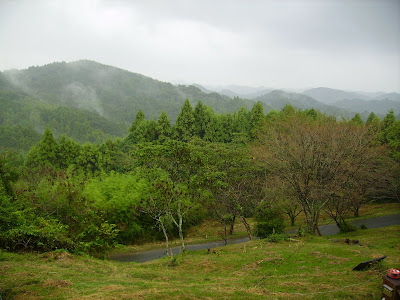
This past Thursday and Friday I, along with my 2 colleagues, took 20 teenage students to Gankoyama - a campsite in Chiba - the big, rural peninsula near Tokyo.
.
Overall I'd say the trip was a success. The most stressful part of the trip was getting there because I wasn't sure about the bus from Yokohama to Chiba -- if there'd be space on the public bus for us all and how to purchase tickets. I met 15 of the students at 8am at school and herded them from school to the train station, onto a train, to Yokohama station and through the massive station to the bus terminal. We arrived at 8:30am where we were supposed to meet my 2 colleagues and the other 5 students. The students were there but the teachers were not. I was not pleased. Eventually we all bought tickets and boarded the 9am bus. Around 10:30am we transferred buses to a private charter we booked which took us another 1/2 hour to the campsite.
.
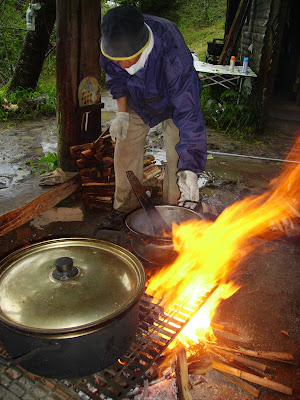
Almost immediately after arriving, it started raining and it pretty much poured until just after we left the campsite the next day! It was a cold, wet, muddy mess but it was fun. The kids made bow and arrows, cooked, chopped wood, relaxed, and fooled around.
.
We left on Friday at 2pm and retraced our steps back to Yokohama around 5pm. Despite the whole trip lasting less than 48 hours it seemed a lot longer!
.
For the spring we are considering a bigger trip to Hiroshima.
.

Monday, October 13, 2008

Hiking Japanese-Style

Saturday, Yumi and I headed out to Mt. Takao to meet up with Kayo to climb the mountain (elevation 600 meters = 1900 feet). Apparently there are ugly big-headed monkeys there but we didn't see them. It was a beautiful day and we had a nice time. At higher elevations we got nice views of Tokyo, Yokohama, and other mountains. It wasn't the clearest day unfortunately. If it were clearer we could have seen Mt. Fuji. We left the apartment at 8:30am and arrived 2 hours and several train rides later. We climbed from 11am until about 3pm then headed to the Shinjuku area of Tokyo to do a bit of window shopping and have dinner. We finally got back home around 12 hours after we originally left.
.
A few observations from the hike:
1. Japanese love dogs; specifically small dogs and they love taking them everywhere they go.
2. It is particularly Japanese that the whole path up the mountain was paved.
3. It is also typical that there were shops and vending machines all the way up.
4. Of course there were shrines, temples, and various other statues along the way.
5. Perhaps needless to say, in this country of 125,000,000 people squeezed into the size of California and being just outside of a conurbanation of 35,000,000 people (the largest in the world), it was crowded!

Mt. Takao Pictures

Takao
View SlideShare presentation or Upload your own.

Last Weekend

Last Saturday, Yumi, my friend Tomo, an acquaintance Misa, and a colleague Jonathan went to see the Carp play the Bay Stars. On the up side, it was a gorgeous day and to paraphrase an old adage, the worst day at a baseball game is better than the best day working. On the downside, the Carp not only lost, not only lowered my record while watching them to 0-5, but lost to a downright horrible team who has a record of 48-94 (0.338 winning percentage) and came into the game having lost 14 straight games! The hapless Bay Stars not only won but beat up the Carp 14-5 and knocked around their pitcher, Colby Lewis who came in with a spectacular 2.45 ERA! Tomo says I need to go to a shrine and rid myself of this evil spell; maybe he's on to something. Things to notice in the photo: the background features Japan's tallest building (Landmark Tower), the YMCA building right behind the scoreboard is where I work, and the score was 13-3 in the 6th inning and the Bay Stars had men on 2nd and 3rd.
.
.
On Sunday, Yumi and I went to a small, local festival and ate lunch before running errands. While some things were familiar (some music, games, rides, kids), some things were a bit different...
.


Thursday, September 11, 2008

Kanji

I have much to say about the presidential race but that will wait until the weekend. For now, I'll restrict my post to my latest encounter in Japanese: kanji. Hiragana is the general syllabic alphabet, katakana is the syllabic alphabet for words of foreign origin, and kanji is the last frontier; it's the logographic (pictogram) alphabet.
.
It occurred to me that with kanji now in the mix, that the level of difficulty is significantly higher. For the majority of English words, there is a one-to-one correlation between the object and the word and that is all you need to know.
.
1. See moon and recall the word "moon".
2. See the word "moon" and recall a picture of the moon.
Many kanji represent more than one object and almost all have at least two pronunciations. That gives the following relationships:

1. See the moon and recall the word "つき".

2. See the moon and recall the kanji character "月".

3. See the word "つき" and recall a picture of the moon.

4. See the word "つき" and recall the kanji character "月".

5. See the kanji character "月" and recall the word "つき".

6. See the kanji character "月" and recall a picture of the moon.

7. See the kanji character "月" and recall "month".

8. See the kanji character "月" and recall the words "げつ" and "がつ".

9. Think of "month" and recall the kanji character "月".

10. Think of "month" and recall the words "げつ" and "がつ".

11. See the words "げつ" and "がつ" and recall the kanji character "月".

12. See the words "げつ" and "がつ" and recall the word "month".

Saturday, August 30, 2008

Dispatches from Nihongo

My latest "oy-vey moment" with Japanese came during this past week's lesson.
.
Counting in English:
One, two, three... regardless of what the items are (a few exceptions for things like floors - first, second, third...).
.
Counting in Japanese:
Numbers: ichi, ni, san...
Things: hitotsu, futatsu, mittsu...
People: hitori, futari, sannin...
.
Clothes: icchaku, nicchaku, sancchaku...
Not to be confused with:
Socks and Shoes: issoku, nisoku, sanzoku...
.
"Small Things": ikko, niko, sanko...
Not including:
"Small Animals, Fish & Insects": ippiki, nihiki, sanbiki...
.
I swear I'm not making this stuff up:
Drinks: ippai, nihai, sanbai...
Houses: ikken, niken, sangen...
Machines and Vehicles: ichidai, nidai, sandai...
Books and Notebooks: issatsu, nisatsu, sansatsu...
"Thin and Flat Things": ichimai, nimai, sanmai...
"Thin and Long Things": ippon, nihon, sanbon...
.
Dear lord!

Monday, August 18, 2008

Nikko

Almost exactly 3 years ago, I was on my first trip to Japan. I had prepared my itinerary carefully: a day in Tokyo, 3 days in Kyoto/Nara, Student Pugwash pre-conference in Hiroshima (Wed. July 20 - Fri. July 22), Senior Pugwash conference (Sat. July 23 - Wed. July 27), then 2 more days in Tokyo before returning to Belfast. For one of my final Tokyo days I had planned to visit Nikko, a town 2 hours north of Tokyo which houses many well-known temples and shrines. As things turned out, I met this woman there who I was quite smitten with and so abandoned my Nikko day to spend another day with her in Hiroshima. It turned out to be a good call, but it did take 3 years for me to finally get to Nikko.

Since Nikko is 2 hours north of Tokyo by train and I am 1 1/2 - 2 hours south of Tokyo, it made for a lot of trains and travel time. I left the apartment at 8:30 am and didn't arrive there until 1:30 pm. I left Nikko at 6:00 pm and arrived back home at 11:00 pm. That means I spent 10 hours (and about ¥5000 - approximately $50) to spend 4 1/2 hours there!

But it was worth it; the setting is gorgeous - up in the green mountains surrounded by huge trees. And the temples, shrines, toriis (gates), and other historical items were interesting and beautiful.

Nikko Pictures

Nikko Pictures
View SlideShare presentation or Upload your own.

Saturday, August 16, 2008

Japundit

I've been on a self-imposed two-week moritorium on Japundit because I was annoyed at the owner of the site once again starting a partisan attack and then censoring me when I respond. This particular episode was him taking a swipe at "weird and liberal Californians." I am currently ignoring his current bait of asking if the Spanish basketball team's photo was really racist.

Nevertheless I do enjoy the outlet for sharing what I read about Japan and engaging in conversations about Japan and its culture. So today, I ended the moritorium and we'll see how things go. Since my last Japundit post here, I've written posts there on the death of the founder of Benihana's, Asian tourists in Japan, lawyers in rural
Japan, Japanese photographer Hiroshi Hamaya, tourism in Japan, and foreign labor in Japan. I think that the two most interesting articles are the one on Rocky Aoki of Benihana's fame and foreign labor in Japan. Aoki created good restaurants and led an intersting life. Foreign labor here is a controversial and touchy topic and gives a window into the culture here.
.

Paperwork

For the second time in a week, I successfully battled the Japanese bureaucracy. On Monday, Yumi and I officially registered our marriage at the local ward office. On Thursday, I obtained my new visa and re-entry permit.

A couple notes of interest regarding the visa...
1. Japan is the only country I know of which requires a separate visa and re-entry permit; normally the visa *is* the re-entry permit.

2. The combined cost was about $100 which has to be paid at a local convenience store. This is actually very common here - many things including utility bills, sporting tickets, train tickets, and even mail order merchandise is paid for at convenience stores. Money is very different here: cheques are unheard of and credit cards are rare; almost everything is done with cash. Amazingly, you often can get the items before paying for them and then you are just trusted to go to a convenience store to pay!

For the visa, since it was a nice day I rode my bike the 11 km (6.5 miles) each way and then stopped off at Yamashita Park and the Osanbashi Pier. Both are within spitting distance of my school but I never made it until this week. Both offer nice views of Yokohama.

Friday, August 15, 2008

More Baseball

Last weekend, I ventured up to Tokyo to visit my friend, Tomo and then go to see the Japanese Olympic team play the Central League All-Stars.
.
First, I took 3 or 4 trains for an hour and a half up to Tomo's apartment at the campus of the university where he is a chemistry post-doc. We hung out with his 1-year old daughter, Nao for a while. Later, his wife, Kyo came home and made us an udon (noodle) lunch and then we were off to the Tokyo Dome (aka The Big Egg) for the game. After our 1-hour journey, we arrived.


.
The game was ok - I'm not really into exhibition games but it was nice to see the best of the Nippon League. The game was a rout, with the Olympic team (the best players) losing 11-2. I don't like these games because a) I don't know who to root for and b) it doesn't count for anything. I was surprised that Tomo was rooting for the All-Stars because they had 4 Hiroshima Carp players whereas the Olympic team had none (that tells you about the strength of the Carp).

I find it very interesting that Japanese baseball is continuing during the Olympics without the 24 best players (some teams losing 3 or 4 players and others losing none). It would seem to throw into question the results of the season.
.
After the game we went to the Japanese Baseball Hall of Fame which is housed in the Tokyo Dome. It's not very big but it's not inconsequential either. I most liked the displays on the World Baseball Classic victory and their record holders. The consecutive games played record holder and retired Hiroshima Carp player Sachio Kinugasa played 2215 games in a row! That's better than Lou Gehrig's number (2130) but was finally eclipsed by Cal Ripken (2632).
.


.
The all-time home run champion is Sadahara Oh who played for the Tokyo Giants. His record of 868 home runs is pretty mind-boggling. 40 home runs a year is very good. 20 seasons is a long career. Yet 40 home runs for 20 consecutive seasons would still put someone 68 home runs short! Barry Bonds' (drug-enhanced) U.S. record is 762.
.


.
Another 1 1/2 hours on trains brought me back home. For those keeping score at home: 4 hours of travel for about 4 hours of baseball and an hour and a half with Nao.